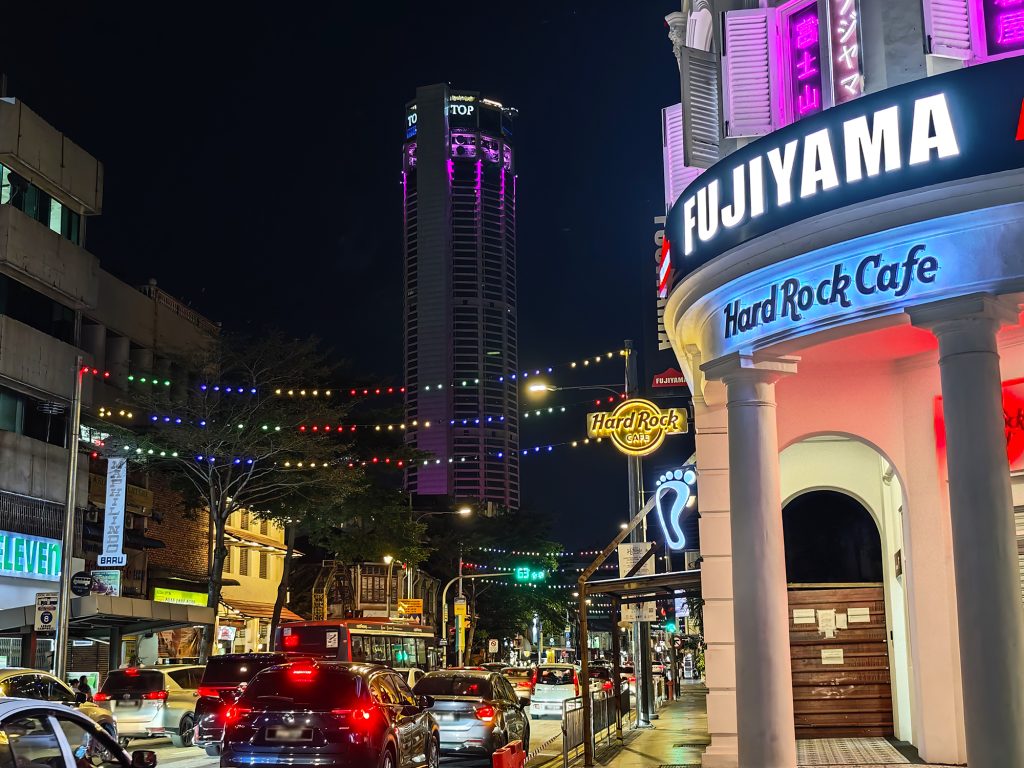
Penang Road (Jalan Penang) is one of George Town’s oldest and liveliest streets, connecting colonial-era landmarks with modern spots like Komtar and Chowrasta Market. Known for its mix of heritage, street food, and nightlife—especially around Upper Penang Road—it remains a key hub for both locals and tourists.
Khoo Kongsi, officially known as Leong San Tong Khoo Kongsi, is the grandest Hokkien clanhouse in Malaysia and one of George Town’s most iconic heritage sites. Located at Cannon Square amidst a network of old shophouses, it was rebuilt in 1906 after a fire destroyed the original structure—featuring a magnificent ancestral hall, operatic stage, administrative blocks, and rows of terrace houses forming a tightly-knit clan complex . The main hall, Leong San Tong (Dragon Mountain Hall), showcases exquisite Southern Fujian craftsmanship—with detailed stone carvings, ornate wooden beams, gilded decorations, and a rich visual tapestry of murals and ancestral tablets. The site also houses a small museum tracing the Khoo family’s migration from Fujian, clan governance, and community influence in Penang’s development.
The 17th annualGeorge Town Heritage Celebrations—themed “Doors and Doorways”—ran from 5–7 July 2025, inviting visitors to step into Penang’s hidden past. The event featured immersive storytelling, artisan workshops (from pottery to traditional snacks), heritage-themed performances, and behind-the-scenes access to eight historic Category 1 heritage buildings. Designed to celebrate George Town’s living traditions, the celebration focuses on cultural connections, community engagement, and heritage education. The event is located at the areas around Armenian Street this year.
An art mural painted by local artist Vincent Phang depicting the famous Lum Lai Duck Meat Koay Teow Th’ng stall at Cecil Street Market. This mural can be found at the corner shophouse of McNair Street and Cecil Street Market junction.
Located at Cecil Street Market in George Town, Penang, this family-run stall has served its signature duck meat kōay teow th’ng since the late 1970s. It earned a Bib Gourmand in the Michelin Guide Kuala Lumpur & Penang 2025, praised for its savory clear broth packed with umami, silky duck, pork, fish cakes, fish balls, duck blood jelly, and aromatic fried garlic and shallot bits—served over smooth flat rice noodles.
The “Beacon of Hope” mural, also known as Bomba Street Art, is a 100-meter-long public artwork beside Malaysia’s oldest fire station on Beach Street, Penang. Painted by muralist Tam Yaw Tyng in 2023, it features 18 vibrant panels that honor the bravery of firefighters, including tributes to seven fallen heroes. Commissioned by The Learning Kingdom Education and supported by the Penang Fire Department, the mural transforms the alleyway into a meaningful tribute to courage and sacrifice—now a popular stop in George Town’s UNESCO heritage zone.
In Malaysia, one of the most eye-catching plants you’ll often see brightening up fences, gates, and roadsides is the bougainvillea, known locally as pokok bunga kertas. Its name, which translates to “paper flower,” perfectly describes the thin, papery texture of its vibrant bracts that come in shades of pink, purple, red, orange, and white. Despite its delicate appearance, this hardy plant thrives in the tropical heat with minimal care, making it a favorite for gardens and public spaces. Whether it’s cascading over a trellis or standing tall like a small tree, the bougainvillea adds a burst of cheerful color wherever it grows—an unmistakable part of the Malaysian landscape.
During the George Town Festival, Spanish artist Isaac Cordal brought a unique touch to Penang by placing around 20 tiny cement sculptures—known as Cement Eclipses—throughout George Town. These small, somber-looking figures, about 17–20 cm tall, can be found perched on walls, ledges, and electrical boxes, often high above eye level. Blending quietly into the city’s heritage architecture, they invite passersby to pause, look up, and discover hidden corners of the city—like a little art treasure hunt tucked into the urban landscape.
Here is the list of locations where you can hunt/find these tiny art sculptures (note: some may no longer be there anymore or removed):
Armenian Street Junction (opposite the famous bicycle mural)
The Penang trishaw, which looks like a small buggy attached to a bicycle, first appeared around 1935–1936 with about 50 units managed by the city. It used to be a common way for locals to get around, but today it’s mostly a fun ride for tourists—complete with bright neon lights, music, and guided trips through George Town’s narrow streets and famous murals.