


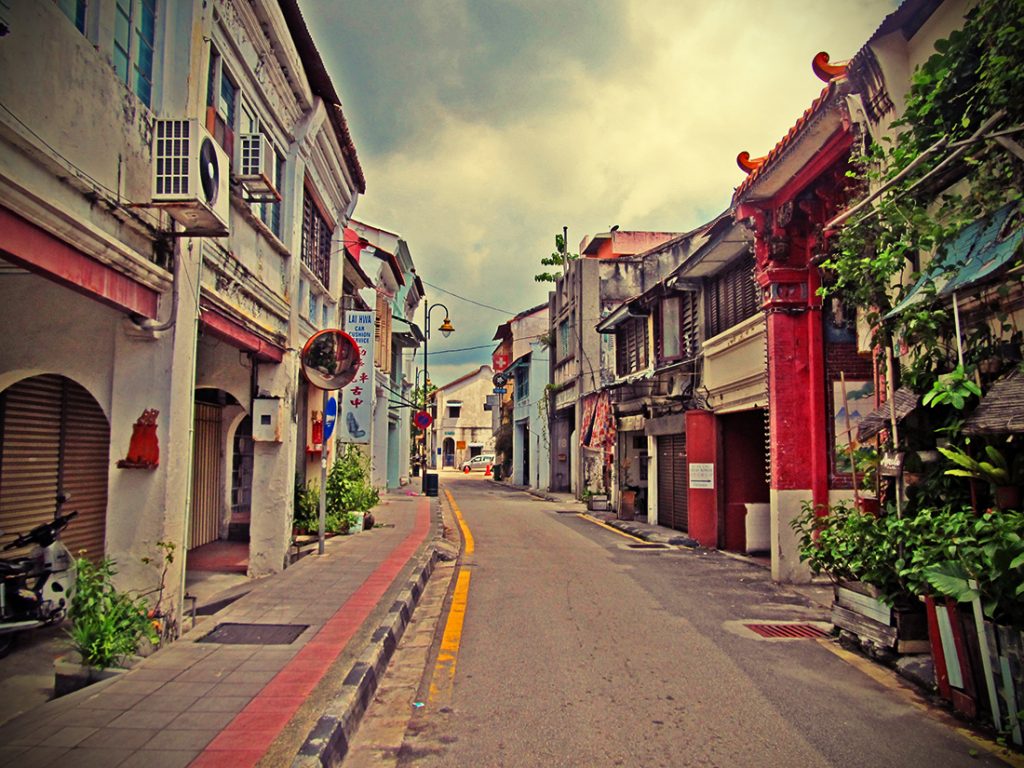
The popular historical Armenian Street is located at the heart of heritage zone in George Town, Penang.
The street’s name originates from a the Armenian community residing in the area including an Armenian family who had their home at the junction of the now Armenian Street and Beach Street in the early part of the 19th century. The famous Armenians amongst these were the Sarkies Brothers who later founded the Eastern & Oriental Hotel in the 1880s. After the Armenians left Penang, the street was populated by the Chinese community and they in turn, established some of the more famous clan houses in the area.
Armenian Street is currently home to Penang’s most famous art mural drawn by Ernest Zacharevic and various local shops and cafes catering to the tourists who visit the street.






Located within Fort Cornwallis, this historical lighthouse is one of the oldest lighthouses in Malaysia. Built in 1882 during the British administration, it was known as the Fort Point Lighthouse. The lighthouse twas made of steel framework, which is a stark contrast with the rest of the fort. During the renovation in 1914 it was renamed as Penang Harbour Lighthouse. The 21 meters high minaret is made from white iron frame with depth filed covering of 16 nautical miles deep.


The Han Jiang Teochew Temple is a Chinese temple located along Lebuh Chulia in George Town and right at the cross junction of Jalan Masjid Kapitan Keling. It is the community temple of the Penang Teochew Association. Completed in 1870, the Hanjiang Ancestral Temple is the community temple of the Penang Teochew Association which was formed in 1855 by six Teochew migrants.
The temple has suffered from long years of wear and tear as well as neglect over the year until a special committee was then formed in 2002 to conduct a restoration project of the temple which was later completed in 2005. The temple is carefully restored in its unique old Chinese architecture and to reflect its history properly.


The Penang Old City Hall and Town Hall are located next to each other at the Esplanade. The two buildings, also located at the World Heritage Site, are fine examples of British colonial buildings and architecture.

The Old City Hall was built in 1903 with a typical design of the British Palladian architecture during the British colonial era. The design of the Old City Hall is almost similar to the nearby Old Town Hall, which features the balcony as a main element overlooking the esplanade. The Old City Hall is currently houses the offices of the Penang Municipal Council (MPPP).


The Old Town Hall (as shown below) was once a premier site for social gathering and activities in George Town for the town’s European community and is also the oldest Municipal Building in Penang. The building’s foundation was first laid on 1st January 1879 by Lt. Governor Sir Archibald Edward Harbord Anson. The building was built over a land area of 70,711 square feet facing the famous Esplanade. Upon completion in 1880, the building was officiated by Frederick Weld, the then Governor of the Straits Settlements.


The Cenotaph located at the Esplanade is a historical and heritage war memorial erected by the British empire. The cenotaph was unveiled by the Prince of Wales on 31 March 1922, at the Esplanade seafront to remember the losses during World War I battles.
The Penang Veterans Association also built another small monument besides the cenotaph to remember those killed in World War II, Siam-Burma Death Railway, Malayan Emergency, Indonesian Confrontation and the Reinsurgency period.


The Cheah Kongsi is one of the oldest and intriguing clan temple to be established in Penang in the year 1873.
Situated right at heart of Georgetown (Armenian Street), the Cheah Kongsi possessed a intricate and unique architecture as well as design which reflects buildings of ancient Chinese. The Cheah clan in Penang is the oldest of the five major Hokkien clan associations in Penang. Historically Cheah Kongsi was founded by Cheah Yam, a clan member who came from a village called Sek Tong in the Hokkien province of China.
Click here for the Location Map and the official website of the Cheah Kongsi is http://cheahkongsi.com.my/.


Built during the British rule, Fort Cornwallis is the largest fort still remaining in Malaysia. This old star-shaped fort is situated at the north-eastern side of Penang island. The fort is named after Charles Cornwallis, 1st Marquess Cornwallis who was the Governor General of Bengal, India in the late 18th century.
Captain Sir Francis Light took possession of the island from the Sultan of Kedah in 1786 and built the original fort. It was a nibong (Malay: palm trunk) stockade with no permanent structures, covering an area of 417.6 square feet (38.80 m2). Despite the fort’s original purpose to serve the Royal artillery troops and the military, historically it was more for administrative purpose than defensive.

The Church of the Assumption is located at Farquhar Street, George Town, Penang and it is nearby St George’s Cathedral. The Church of the Assumption was founded in 1786, when Captain Francis Light first came to Penang. It remained as the seat of the bishop of Penang from 1955-2003 and it is also a World Heritage Church.
In 1786, Captain Francis Light landed on Penang Island and named it Prince of Wales Island. He set up the Fort Cornwallis. In conjunction with their landing in Penang which coincides with the feast of the Assumption of The Blessed Mary on 15 August that year, he and his companions built a church and named it Church of the Assumption. It was the first Roman Catholic church in the northern region of Malaysia, as well as the first church built after the British landed in Penang. They went on to control Malaya later on.
(Source: http://en.wikipedia.org/wiki/Church_of_the_Assumption_%28Penang%29)


The Beach Street in Penang is a busy street during the weekdays as it is also known as Penang’s banking or financial district. Rows of historical and heritage buildings converted into banks and financial institutions lined up the street. Most of these heritage buildings retain their old appearance and architecture despite being used as modern financial centers by their owners.
Being one of the oldest streets in Malaysia, Beach Street’s history stretches back to the founding of Penang island as a trading port. Prior to a land reclamation during the late 1800s to early 1900s, Beach Street was actually built along the coastline of eastern Penang island in the 1780s. Hence, the shape of the street was curved and it started from Pesara King Edward roundabout (north) all the way to C.Y. Choy Road (south).


