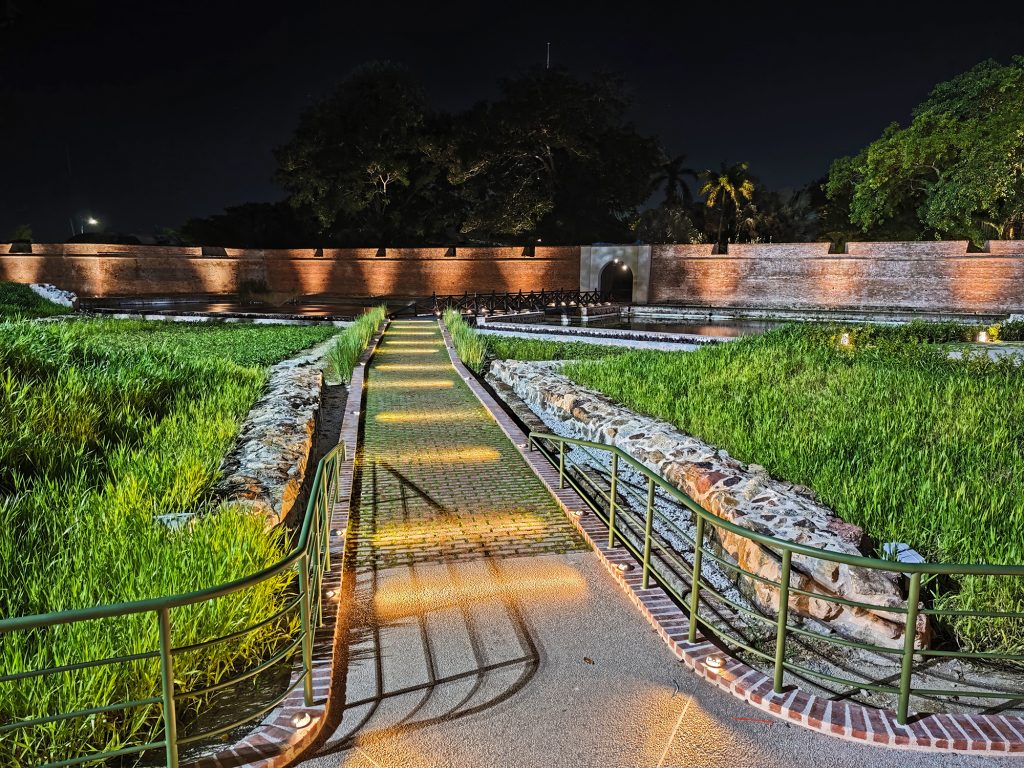
The newly restored western moat at Fort Cornwallis in George Town is set to reopen with an upgraded walkway and improved drainage, reviving a historical feature that once protected the 18th-century fort from invasions.
The newly restored western moat at Fort Cornwallis in George Town is set to reopen with an upgraded walkway and improved drainage, reviving a historical feature that once protected the 18th-century fort from invasions.

Wisma Kastam (formerly the Malayan Railway Building), was completed in 1909 in George Town, Penang, and designed in Edwardian Baroque style by the British architect Arthur Benison Hubback. Though it was built as a railway terminus, it never housed any actual train tracks—passengers would come to the station, then take a ferry across to Butterworth instead.
Over time, it served many functions: offices, a clock tower, customs building, waiting hall, and more. Because of its utilitarian role without actual rail lines, locals refer to it as a “ghost station.” It has now been granted Grade I heritage status and is under new leaseholders, with efforts to preserve its architecture and legacy.
The building is located along China Street Ghaut, and is also known as the “Big Ben” of Penang.

A trishaw in Penang, locally called “beca,” is a traditional three-wheeled bicycle taxi mainly used by tourists to explore George Town and Penang’s heritage sites. The trishaw ride is a popular and relaxing way to see local street art, temples, mosques, and historic buildings around the UNESCO World Heritage Site area. Typically, rides cost around RM 40 to RM 50 per hour, with drivers often serving both as guides sharing local history and navigating the narrow and busy streets safely.
Trishaws hold historical importance since the 1930s and remain a cultural symbol despite the decline in daily local use, mostly catering now to visitors who want an authentic and leisurely tour experience around Penang’s charming spots.

The Fort Cornwallis moat in Penang has undergone a major restoration set to be fully completed and opened to the public by July 2025, featuring the reinstatement of its southern and western sections to form a 4,000 square meter water basin about 0.9 meters deep, holding approximately 3,600 cubic meters of water. Using traditional building methods for long-term stability, the restoration includes ecological enhancements like a mechanical sand filter and a vegetated bio-retention swale, aligning with sustainable development goals. The project, costing around RM23.4 million and supported by the Penang state government, Think City, and Hasanah Foundation, also includes landscaping improvements, new visitor amenities, and a rebuilt food court adjacent to the moat, designed to complement the historic site.
This restoration revives the fort’s original defensive features from its 1804 construction, enhancing heritage conservation and turning the moat area into an attractive green public space and educational site for both locals and tourists, particularly timed to coincide with the George Town UNESCO World Heritage celebrations.


Originally constructed by the British East India Company in 1804 as a defensive measure during the Napoleonic Wars, the moat was filled in 1921 due to public health concerns (malaria) and construction developments.

The five-foot way is a covered walkway found in front of many shophouses in Malaysia, especially in places like George Town, Penang. True to its name, it’s typically about five feet wide and provides shelter from sun and rain, allowing people to walk comfortably along rows of shops. It’s a unique blend of architecture and function—often lively with activity, from street vendors to chatting locals—and reflects the colonial and multicultural heritage of Malaysian towns.


Acheen Street, also known as Acheh Street (Lebuh Acheh), is located in the heart of George Town’s heritage zone. It was named in honor of the Acehnese community that once resided there.
This historic street is also home to the renowned Acheen Street Mosque, a distinctive and historically significant place of worship. Recognizable by its iconic minaret, the mosque stands at the junction of Acheen Street and Cannon Street.
Fun Fact: Did you know that Acheen Street was once a bustling hub for traders and pilgrims traveling to Mecca? In the 19th century, it played a key role as a stopover for Hajj pilgrims from the region, thanks to the Acehnese merchants who facilitated their journey.

The Whiteaways Arcade on Beach Street, George Town, is a historic colonial-style building dating back to 1903. Recently renovated into a bustling commercial center, it features an art gallery, exhibition spaces, trendy cafes, and diverse retail shops. Visit the Whiteaways Arcade to explore its unique blend of history and modernity, right in the heart of George Town.
A stroll along Union Street on a somewhat quiet Sunday.

Union Street (or Lebuh Union) is a rear road of the old Central Police Station of George Town in Beach Street. The street was reportedly named to commemorate the Act of Union (1800) which created the United Kingdom of Great Britain and Ireland in 1801. The main Penang Maybank branch is located along this street.


The George hotel, located at Penang Road, in the heart of George Town itself.

The Prestige hotel, located at Church Street Ghaut, George Town

Completed in 1931, the Penang Buddhist Association is located along Anson Road in George Town. The old Straits Eclectic style building is a popular place for Buddhists in Penang to participate in various religious and communal activities.
Apart from Wesak Day, many people also usually visit it on the first day of Chinese New Year for new year prayers.

