With scenes from around Penang.


Revealed as Malaysia’s first urban archaeological park, part of the Sia Boey area in George Town has been rejuvenated and converted into a new public park. Sia Boey was once a busy place for the locals as there was a market, a canal that enabled small boats to come in and with its close proximity to the sea, Sia Boey was also a bustling trading station in the old days.


After the old Sia Boey market was closed and the nearby shops were relocated elsewhere, the area was abandoned for a time until the start of the Sia Boey Rejuvenation Project – headed by the Penang Development Corporation and George Town World Heritage Incorporated. The project is aimed at revitalizing the entire Sia Boey area, with the urban park being the first phase that is completed.
Colorful lanterns adorning the Armenian Street Park in George Town, in conjunction with the celebration of the Chinese Mid-Autumn Lantern Festival.


The Han Jiang Teochew Temple (or Hanjiang Ancestral Temple) is a Chinese temple located along Chulia Street (Lebuh Chulia) in George Town and right at the cross junction of Jalan Masjid Kapitan Keling. It is the community temple of the Penang Teochew Association. Completed in 1870, it serves as the community temple of the Penang Teochew Association which was formed in 1855 by six Teochew migrants.


A large art mural depicting a popular local bread seller in Balik Pulau town. According to local artist Andhar A. Samah who created the mural with several others, the bread seller known as Uncle Muniandi (or “Uncle Roti”) is a legend in Balik Pulau who is recognized by everyone there regardless of race. The mural was also created in conjunction with the Balik Pulau Festival.


Another art mural painted on the old residential flat of Balik Pulau called Lily Garden. The fish art mural is created by local artist Nash Arts in conjunction with the Balik Pulau Festival in Penang.
A walk through the usually crowded street of Lebuh Keng Kwee (or Keng Kwee Street), which is best known for arguably Penang’s best Cendol stall.

A shot of a butterfly resting on a leaf at Entopia Butterfly Garden in Teluk Bahang, Penang.


Cheong Fatt Tze Mansion is a historical and cultural rich building located along Leith Street in George Town, Penang. A winner of multiple historical and heritage awards including the “Most Excellent Project” Award at the UNESCO Heritage Awards 2000, the blue mansion is one of the most visited places and a definite tourist destination in Penang. The mansion is said to be one of the two of its kind outside China which also features architecture design of both Chinese and Western influences. The mansion was built by a famous Chinese merchant in 1880s named Cheong Fatt Tze and it has 38 rooms, 5 granite-paved courtyards, 7 staircases with 220 vernacular timber louvre windows.
During his time, Cheong Fatt Tze was also known as the “the Rockefeller of the East” and had helped a lot in building business and diplomatic relationship between the Chinese and Western governments. His legacy and contributions in the were so influential that during his death, top Chinese officials came all the way from China to attend his funeral while both the British and the Dutch authorities ordered flags to be flown at half mast in honour of him.
Featured in a number of movies (such as Crazy Rich Asians), the mansion now also houses a boutique hotel and a restaurant. It is also opens for public guided tour for a few slots of time of the day.
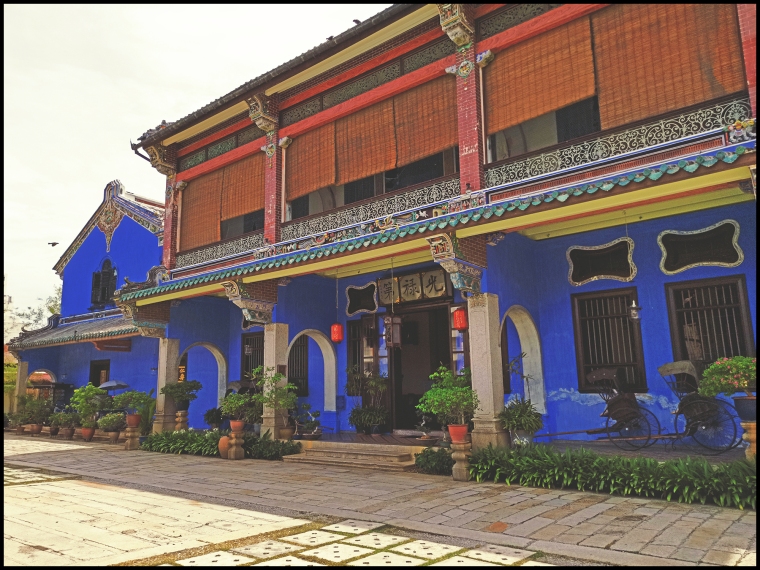
Cheong Fatt Tze Mansion, Leith Street, George Town.